NMN Dosage: How Much Should You Actually Take?
Comparison of Prices, Services & Prescribing Standards Finals


Free shipping on all orders
30-Day Guarantee
Comparison of Prices, Services & Prescribing Standards Finals

When I started researching NMN seriously, one of the first things I noticed was how wildly the dosage recommendations varied. One article said 250 mg. Another said 1,000 mg. A podcast guest swore by 1,500 mg before breakfast. No one seemed to agree, and most of the confident claims were not backed by much more than a product page. That gap between the marketing noise and what the actual research shows is exactly why I wanted to write this.
Quick answer: Most human trials have tested doses in the range of 250 mg to 900 mg per day and found them to be well tolerated. If you are new to NMN, starting toward the lower end of that range and assessing how your body responds is a reasonable approach. There is not strong evidence yet that dramatically higher doses produce proportionally better results.
Human clinical research on NMN is still relatively young compared to the decades of animal studies. The trials that have been completed in people have generally used doses somewhere between 250 mg and 900 mg per day, with some pilot studies going a bit higher. Most of these trials ran for weeks to a few months and measured outcomes like NAD+ levels in blood, metabolic markers, and subjective measures such as energy and fatigue. None of them were large enough or long enough to settle the question definitively, but they do give us a reasonable anchor for what has been studied in humans under some degree of scientific scrutiny.
It is worth being honest about the limits here: the field does not yet have a large, long-term, well-powered randomized controlled trial that can tell us the optimal dose for a specific outcome. What we have are early signals, and those signals cluster mostly in that 250 mg to 900 mg window.
Not necessarily. There is a reasonable hypothesis that NMN dosing follows a curve where you get meaningful benefit as you raise the dose up to a point, but the gains taper off rather than scale linearly. The body has a finite capacity to convert NMN into NAD+ at any given time, and pushing far past that threshold may not translate into meaningfully more cellular NAD+. Some researchers have also pointed out that the oral bioavailability of NMN can vary depending on the form and delivery method, which complicates direct dose comparisons across studies.
The practical takeaway: chasing very high doses because "more must be better" is not well supported by the current evidence. Starting at a moderate, studied dose and observing your own response is more rational than immediately going to the top of the range.
Timing is one of the more genuinely interesting questions in NMN research. NAD+ metabolism is connected to circadian biology, and some researchers have suggested that morning dosing may align better with the body's natural rhythm of NAD+ fluctuation across the day. A few trials have specifically used morning administration, which is part of why morning has become the conventional recommendation.
On the food question: the available evidence does not give a clear directive on taking NMN with or without food. Some people find it easier on their stomach with a small meal. Others prefer it fasted. Neither approach appears to undermine absorption in a clinically meaningful way based on what has been published so far.
In the human trials completed to date, NMN at doses in the studied range has generally been reported as well tolerated, with no serious adverse events attributed to the supplement. Some participants have noted mild digestive discomfort, particularly at higher doses or when taken on an empty stomach. That is worth knowing if you are prone to GI sensitivity.
Longer-term safety data in large populations does not yet exist, simply because the research is still catching up. If you are on medications or have an existing health condition, talking to a healthcare provider before starting NMN is sensible, not just a legal disclaimer. NMN interacts with NAD+ metabolism, which touches a wide range of biological processes.
NMN's classification in Canada has been evolving. Health Canada's position on NMN as a natural health product has shifted over the past few years, and the regulatory landscape is not fully settled. If you are purchasing NMN in Canada, checking the current status directly with Health Canada or looking for products with a valid Natural Product Number (NPN) is worth doing. Regulations can change, and what applied when this post was written may not reflect the current rules by the time you read it.
Most people taking NMN slot it into their morning routine, often alongside other morning supplements or before breakfast. The logic is reasonable: if NAD+ metabolism has a circadian component, earlier in the day may make more sense than evening. That said, consistency likely matters more than the exact hour. If you will reliably take it mid-morning with your coffee but forget it at 7 AM, take it mid-morning. A supplement you consistently take at a slightly imperfect time is more useful than one you keep skipping because the timing feels rigid.
Our NMN supplement is formulated at 600 mg per capsule. We landed on that dose because it sits within the range that has been studied in human trials, it is a practical single-capsule serving, and it gives people who want to start lower the option to take it every other day or half a capsule if they prefer a gentler start. I want to be straightforward: 600 mg is not a magic number. Individual needs vary based on age, body composition, lifestyle, and what other compounds you are taking alongside it. The research does not yet support prescribing one dose as universally optimal. What I can say is that it is a dose grounded in the existing human research, not pulled from the marketing stratosphere.
There is no established evidence that NMN requires cycling. Most studies have used daily dosing protocols without breaks. Some people choose to cycle supplements as a personal preference, but if you are looking for a research-based reason to cycle NMN specifically, it does not currently exist. Daily use appears to be how most trials have administered it.
Splitting a dose (for example, taking 300 mg in the morning and 300 mg at noon) has not been rigorously compared to single daily dosing in published human trials. Some people find splitting easier on their digestion. Others prefer the simplicity of once daily. Either approach is reasonable; it is a practical decision rather than one where the evidence strongly favors either option.
NAD+ levels are known to decline with age, which has led some researchers to hypothesize that older adults may see more pronounced responses to NMN supplementation. Some trials have specifically enrolled older participants for this reason. Younger adults with generally higher baseline NAD+ levels may experience a smaller relative change. This does not mean NMN is only for older people, but it does inform why age is often a factor in study design.
No. NMN (nicotinamide mononucleotide) is a precursor that the body converts into NAD+. You are not taking NAD+ directly; you are giving your cells a building block. This matters for understanding how it works and why the conversion efficiency in your body affects how much of the dose ends up as functional NAD+. If you want to understand the distinction in more depth, the NMN vs NAD post in the related reading below covers it thoroughly.
The honest answer to "how much NMN should I take?" is: the research is still building, but the doses that have been studied in humans range roughly from 250 mg to 900 mg daily, and that is a sensible window to stay within. Start at the lower end if you are new to it, pay attention to how your body responds, and resist the pull toward very high doses just because a supplement company markets them aggressively. More is not always more, especially with a compound where the science is still catching up to the enthusiasm.
Related reading: NMN vs NAD: Understanding What You're Actually Taking · Can I Take NMN with Caffeine? · NMN Supplement Canada: What's Legal and What Actually Works · NMN (Nicotinamide Mononucleotide)
About the author
Mansour Norouzi is the founder of Live 5AM. He reviews every article on this blog, reads the primary research behind the claims, and writes from a simple bias: show the evidence, name the limitations, and never oversell a supplement.

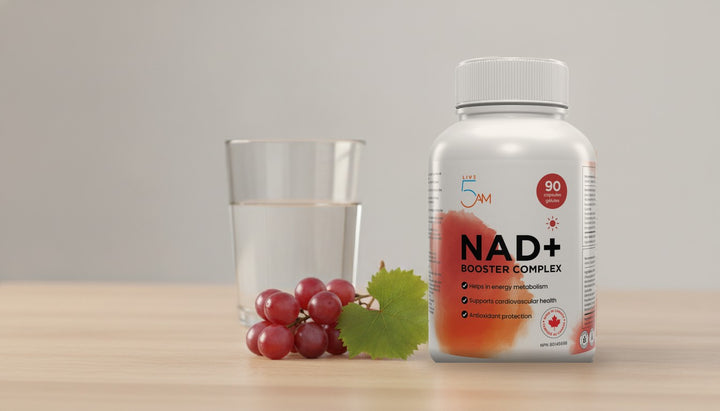
NAD+ precursor. Supports energy metabolism and antioxidant protection.