What Does Ashwagandha Actually Do? A Science-Backed Guide
Comparison of Prices, Services & Prescribing Standards Finals


Free shipping on all orders
30-Day Guarantee
Comparison of Prices, Services & Prescribing Standards Finals

Ashwagandha benefits include support for stress, sleep, and resilience. It is an adaptogen used in Ayurvedic medicine for centuries, and modern research suggests it may help reduce stress and anxiety, support better sleep quality, and promote mental clarity. While not a cure-all, multiple clinical studies indicate it could be a useful tool for people managing daily stress and looking to maintain steady energy and focus.
Let's start with the basics. Ashwagandha (Withania somnifera) is a plant native to India and North Africa. The name literally translates to "smell of the horse," referring both to its earthy aroma and the traditional belief that it imparts horse-like strength and vitality.
For over 3,000 years, it's been a cornerstone of Ayurvedic medicine. But here's what matters today: it's not folklore. Modern research has started to validate why this plant has stuck around for millennia.
Ashwagandha belongs to a category of herbs called adaptogens. Adaptogens aren't magic. They're plants that research suggests may help your body adapt to stress more effectively, support resilience, and promote a return to balance. Think of them as tools, useful in the right context, but not replacements for good sleep, movement, and nutrition.
The active compounds in ashwagandha are called withanolides. These alkaloids are what researchers believe drive most of the plant's effects on the body and mind.
This is the main claim you'll see everywhere. Let's look at what the research actually shows.
A 2019 randomized controlled trial published in Nutrients found that participants taking ashwagandha experienced a significant reduction in cortisol (your main stress hormone) and reported lower anxiety scores compared to placebo after just 60 days. That's meaningful, not miraculous, but real.
Another study in the Journal of Clinical Psychiatry (2000) compared ashwagandha to a common anxiety medication in people with anxiety disorders. Both showed similar improvements. Neither was a dramatic overnight fix, but both showed benefit over time.
Here's the honest truth: ashwagandha isn't a tranquilizer. It won't make anxiety vanish in an hour. What the evidence suggests is that regular use may help your nervous system stay more regulated, making you less reactive to daily stressors. It's like turning down the baseline volume rather than muting individual sounds.
What researchers have found:
The takeaway: research suggests ashwagandha may help, especially for chronic stress. It's not a replacement for sleep, movement, or addressing root causes of stress. But as one tool in your toolkit? The science is encouraging.
Sleep is where many people first notice a difference with ashwagandha, and the research backs this up.
A 2021 study in Cureus examined ashwagandha's effects on sleep quality in adults without diagnosed sleep disorders. Participants reported improvements in sleep onset, sleep quality, and morning refreshedness. The mechanism appears to involve both stress reduction and direct effects on sleep-wake signaling.
This makes sense: when your cortisol is lower and your nervous system is calmer, sleep often improves naturally. Ashwagandha may also influence GABA receptors (similar to how some anxiety medications work), supporting deeper relaxation.
One thing to note: ashwagandha typically takes time to build up in your system. You won't usually notice dramatic improvements in a single night. But after 2 to 4 weeks of consistent use, if sleep quality is going to improve for you, you'll likely notice it.
This is where we need to be careful with claims. Ashwagandha is often marketed as a cognitive enhancer, but the research is more nuanced.
A 2014 study in the Journal of Clinical Psychiatry found that ashwagandha improved reaction time and task performance in a small group of participants. Other research suggests it may support focus by reducing the mental fog that comes with chronic stress.
Here's the distinction: ashwagandha probably doesn't make you "smarter" in the way a stimulant might. Rather, by reducing stress and improving sleep, it may help you access the mental clarity you already have. It removes the fog instead of adding fuel.
If you're chronically stressed and sleep-deprived, yes, you might notice better focus when ashwagandha helps address those underlying issues. If you're already well-rested and managing stress well, the cognitive boost may be minimal.
For people interested in fitness and physical performance, ashwagandha has some interesting supporting evidence.
Research suggests ashwagandha may:
A 2015 study in the Journal of the International Society of Sports Nutrition found that ashwagandha supplementation combined with a resistance training program resulted in greater gains in muscle strength and size compared to training alone. But, and this is important, there was no benefit from ashwagandha alone without the training. It's a supporting tool, not a substitute.
If ashwagandha is right for you, timing matters. Here's where it connects to how driven professionals typically structure their day.
If you're someone who wakes early to get ahead on your day, ashwagandha's stress-reducing effects support a calm, centered start. You're building a steadier foundation before the day's demands hit.
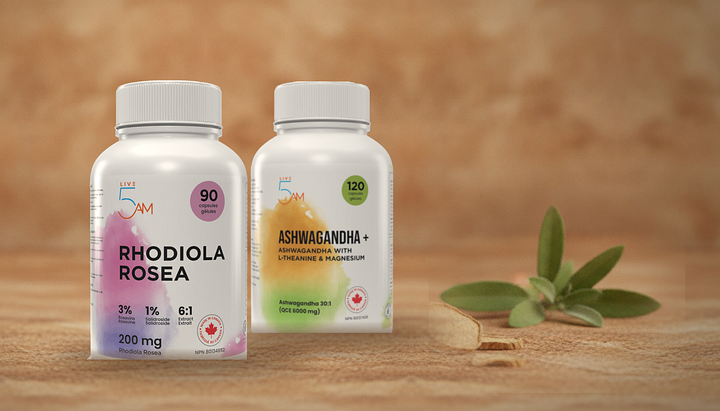
When afternoon stress peaks, ashwagandha helps maintain that baseline calm. Instead of riding cortisol spikes and crashes, you stay more regulated, which is better for decision-making and sustaining focus. This is the moment our Ashwagandha+ with L-Theanine and Magnesium is built for: a midday formulation that pairs adaptogen support with the amino acids and minerals your nervous system actually uses.
As a tool for supporting sleep quality, ashwagandha taken in the evening may help transition your nervous system from "on" to "rest." It doesn't sedate, but it may help you arrive at bedtime in a genuinely calm state. (For the question of when to take ashwagandha for your specific goal, we go deeper in the next post.)
The Live 5AM framework recognizes that sustainable performance isn't about pushing harder. It's about staying balanced across your day. Ashwagandha, when it works for you, is one way to support that balance. It helps you build your pace rather than burn yourself out.
You'll see ashwagandha in capsules, powders, and tinctures. Here's what the research generally supports.
Most clinical studies use ashwagandha extract standardized to 5% withanolides (the active compounds). This allows for consistent dosing and predictable results.
Studies showing benefits typically use 300 to 500 mg daily, often split into two doses.
Most research showing meaningful effects used ashwagandha for at least 4 to 8 weeks. It's not a one-off supplement. It's something you use consistently to feel the difference. (For more on this, see how long ashwagandha takes to work.)
Standardized extracts show more consistent results in research, though some people prefer whole-plant preparations. The choice is somewhat personal, but standardized extracts have stronger evidence behind them.
Ashwagandha is generally well-tolerated. In clinical studies, side effects are typically mild and comparable to placebo.
Potential side effects (usually mild and uncommon):
Important interactions to discuss with your healthcare provider:
This is why a simple conversation with your doctor before starting any new supplement is worthwhile. It's five minutes that can prevent any unintended interactions.
Most people notice effects after 2 to 4 weeks of consistent daily use. Sleep quality sometimes improves first, followed by stress resilience. Don't expect overnight changes.
Yes, it's designed for daily use. Most research studies used continuous daily dosing. Some people cycle it (for example, 5 days on, 2 days off), though this isn't required.
No. Meditation, exercise, sleep, and nutrition are foundational. Ashwagandha is a supporting tool, not a replacement. Best results come when combined with these habits.
Not typically. At normal doses, it supports calm without drowsiness. However, some people are sensitive. If you're one of them, dosing in the evening rather than morning might work better.
Generally yes, though combining multiple adaptogens (ashwagandha, rhodiola, etc.) doesn't have strong evidence. Before combining supplements, a quick conversation with your doctor or a functional medicine practitioner is sensible.
Ashwagandha is one of the better-researched herbal adaptogens we have. The evidence suggests it may meaningfully support stress resilience, sleep quality, and mental clarity, especially if you're chronically stressed. It's not a miracle, but it's also not hype.
What makes it worth considering is that it has real research behind it, mild side effects, and a track record across 3,000 years of traditional use. For driven professionals trying to maintain sustainable performance, it can be a useful part of a broader strategy that includes sleep, movement, good nutrition, and stress management.
The goal isn't to optimize every single thing. It's to build your pace, to create systems that work consistently without burning out. If ashwagandha helps you arrive at that place, it's worth trying. If it doesn't move the needle for you, that's fine too. Everyone's biochemistry is different.
Start with a quality, standardized extract, give it 4 to 6 weeks, and pay attention to how you actually feel. That's the real test.
Medical Disclaimer: This content is educational and not medical advice. Ashwagandha is not intended to diagnose, treat, cure, or prevent any disease. If you have a medical condition, take medications, are pregnant or nursing, or have concerns about starting any supplement, consult your healthcare provider before use. Individual results vary, and ashwagandha may not be appropriate for everyone. Always follow product instructions and recommended dosing guidelines.
Ready to build your pace? Quality sleep, managed stress, and steady focus aren't luxuries. They're the foundation of sustainable high performance. If ashwagandha is part of your toolkit, use it consistently and give it time to work.
Based in Toronto. Live 5AM is a Health Canada NPN-licensed supplement brand built for sustainable performance over hype. Mansour personally reviews every article on this site against source studies and NPN records before it publishes. Reach him at info@live5am.com.

Helps support resistance to stress. Used in Herbal Medicine