Do Adaptogens Really Work? An Evidence-Based Look
Comparison of Prices, Services & Prescribing Standards Finals


Free shipping on all orders
30-Day Guarantee
Comparison of Prices, Services & Prescribing Standards Finals

A few years into running Live 5AM, I've watched "adaptogen" become one of those words that gets slapped on everything from gummies to face cream. That bothers me, because underneath the hype there are a handful of herbs with genuinely interesting research, and they deserve an honest look rather than a marketing glossing-over.
Quick answer: Some adaptogens, particularly ashwagandha and rhodiola, have a reasonable body of human research supporting modest but real effects on stress markers and fatigue. The broader category is heavily over-marketed, and most of the exotic newcomers you see trending have little more than animal data or test-tube studies behind them. The details matter more than the label.
The term was coined in Soviet-era pharmacology in the 1940s to describe substances that help the body resist non-specific stressors, physical, chemical, or biological. It was never a strict regulatory or scientific category; it was a working concept. What it generally implies is that the herb should be safe at normal doses, produce a normalizing effect under stress rather than a stimulant spike, and have some demonstrated action on stress-related physiology. That is a useful framework, but it was always a functional description, not a formal class of compounds with standardized criteria.
Ashwagandha (Withania somnifera) sits at the top of the evidence pile for stress and recovery. Multiple placebo-controlled human trials have looked at its effects on cortisol levels, perceived stress scores, and sleep quality, and the results are consistently in the right direction, though effect sizes are modest and most trials run eight to twelve weeks. Rhodiola rosea has a solid track record in fatigue and cognitive performance research, particularly in studies involving people under acute mental load, such as physicians on night shifts or students during exams. The underlying mechanism likely involves modulation of stress-response pathways and mitochondrial support, though the full picture is still being worked out. These two are the ones I feel confident pointing to when someone asks whether any of this is real.
The category gets into trouble fast when brands promise that an adaptogen will "balance hormones," "eliminate stress," or "optimize your HPA axis" as if you can simply turn a dial. Cortisol is a complex hormone with daily rhythms, and the research shows modest, context-dependent nudges, not normalization to some ideal set point. Mushroom adaptogens like lion's mane and reishi generate a lot of excitement, and some of the underlying science is genuinely interesting, but much of it comes from animal models or in vitro studies, and translating that to meaningful human outcomes is a leap the marketing often skips over. Ashwagandha itself is sometimes oversold: it may help take the edge off chronic stress, but it is not a substitute for sleep, a reasonable workload, or a decent diet.
Adaptogens are not like caffeine: you will not feel something within an hour. The human research generally runs over weeks, and most participants report meaningful changes in the four-to-eight-week range. If you try ashwagandha for three days and shrug, that is not a fair test. A consistent eight-to-twelve-week trial followed by a deliberate break is a reasonable way to actually evaluate what is happening.
Check whether the dose per serving aligns with what human research actually used. A tiny amount hiding behind a "proprietary blend" label is not doing what the studies showed. For ashwagandha, look for an extract standardized to withanolides; for rhodiola, rosavins and salidroside. In Canada, look for a Natural Product Number (NPN) on the label: it means Health Canada reviewed the evidence, which is a meaningful bar many products never clear. Finally, ignore testimonials and look for whether the company cites actual clinical research.
Adaptogens are supportive, not corrective. They work best alongside consistent sleep, movement, and manageable stress, not as a fix for a fundamentally unsustainable routine. Ashwagandha tends to be calmer in effect and suits the evening; rhodiola is more activating and fits earlier in the day. That is not a hard rule, but it is the pattern that holds up across the research and in practice.
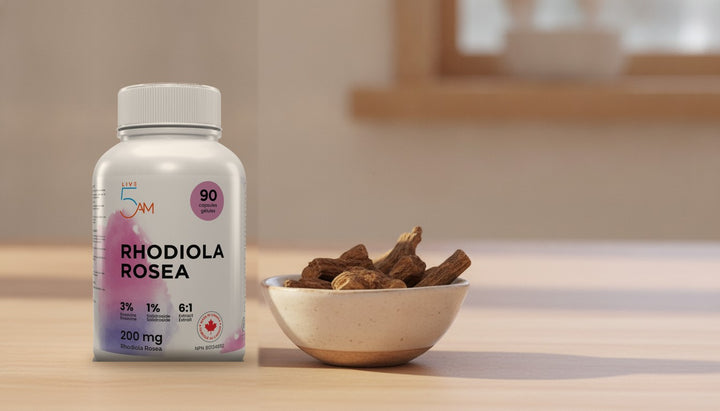
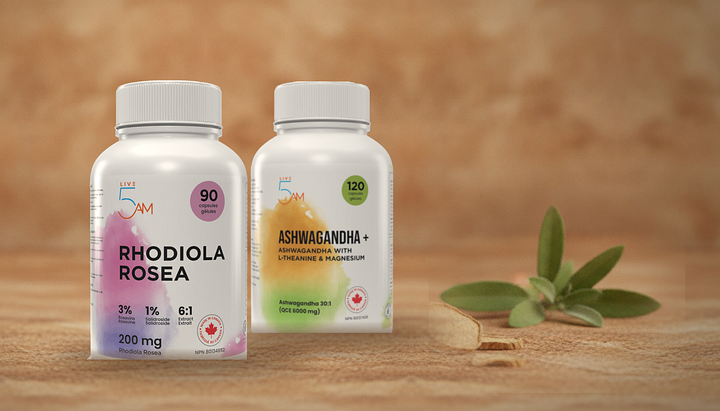
We make two adaptogen products, Ashwagandha + and Rhodiola Rosea, because these two have the most consistent human evidence in the category. Both carry an NPN from Health Canada. I'm not going to tell you they'll transform your stress levels or that the science is settled, because it isn't. The research is real enough to take seriously, the doses are in line with what studies have used, and we built both without branded ingredient premiums in the price. If another herb earns that level of evidence, we'll revisit.
For ashwagandha and rhodiola, the safety data from human trials is reassuring at typical doses, and daily use over several months appears to be well-tolerated by most people. "Safe for most people" is not the same as "safe for everyone," though. People who are pregnant, breastfeeding, on thyroid medication, or managing autoimmune conditions should talk to a healthcare provider first.
There is no known interaction between the two, and some formulas combine them. The more useful question might be whether you want to take them at different times of day, given that ashwagandha tends to suit evenings and rhodiola mornings. Running them together from day one also makes it harder to know which one is contributing what, so some people prefer starting with one, noticing its effects, and then adding the second.
The research does not show a clear biological requirement to cycle ashwagandha or rhodiola the way you might cycle certain stimulants. That said, taking a deliberate break every few months is a practical way to check in on whether they are still doing anything useful for you. It also prevents the habit of taking something indefinitely out of inertia rather than intention. There is more detail on this in the related reading below.
"Nootropic" refers to substances thought to support cognitive function or mental clarity. There is significant overlap with adaptogens: rhodiola is often called both. Neither term is a formal scientific classification with fixed criteria; both are research and marketing shorthand. When you see either word on a label, the more useful question is: what specific research supports this dose for this claimed benefit?
Adaptogens are not magic, and the category is crowded with products that borrow credibility from the few herbs that actually have decent evidence. Ashwagandha and rhodiola are worth taking seriously. The rest of the market deserves more scrutiny than it usually gets. If you decide to try one, pick something with a clear dose, a standardized extract, and an NPN if you're in Canada, and give it a real trial window before drawing conclusions. The honest version of this story is that they can help at the margins, and the margins matter if you're already doing the fundamentals right.
Related reading: Should You Cycle Adaptogens? What the Evidence Says · Are Adaptogens Right for Everyone? · Rhodiola vs Ashwagandha: How to Choose the Right Adaptogen · Ashwagandha +
About the author
Mansour Norouzi is the founder of Live 5AM. He reviews every article on this blog, reads the primary research behind the claims, and writes from a simple bias: show the evidence, name the limitations, and never oversell a supplement.

Helps support resistance to stress. Used in Herbal Medicine