Rhodiola Rosea Dosage and Timing: A Practical Guide
Comparison of Prices, Services & Prescribing Standards Finals


Free shipping on all orders
30-Day Guarantee
Comparison of Prices, Services & Prescribing Standards Finals

People ask me about adaptogens all the time, and rhodiola questions tend to cluster around the same frustration: "I tried it but it kept me up," or "I took it for a few weeks and it stopped doing anything." Almost every time, the issue turns out to be timing or dosage, not the herb itself. Getting those two things right makes a real difference.
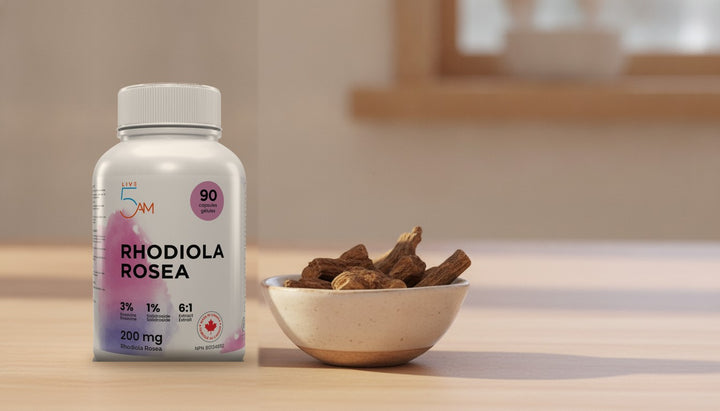
Health Canada's monograph for Rhodiola rosea permits 144 to 680 mg of standardized extract per day, capped at 200 mg in any single dose, and directs against taking it before bedtime. Most licensed Canadian capsules land between 200 and 400 mg daily. Take it in the morning or early afternoon. Live 5AM's Rhodiola Rosea 200 mg (NPN 80134852) is one capsule, once or twice daily, standardized to 3% rosavins and 1% salidroside.
The research on rhodiola tends to cluster around extracts standardized to a combination of rosavins and salidroside, the two marker compounds most associated with its effects. Health Canada's monograph sets the licensed range at 144 to 680 mg of standardized extract per day, with an explicit cap of 200 mg per single dose. That single-dose cap matters and is often missed: a product directing you to take 600 mg at once sits outside what the monograph permits, even though 600 mg spread across the day does not. Most NPN-licensed capsule products land between 200 and 400 mg per day. If you are new to rhodiola, starting at 200 mg is sensible: it is where much of the research is concentrated and it gives your system a chance to respond before you increase anything.
Rhodiola has a different character from most other adaptogens. Ashwagandha, for example, tends to feel calming and pairs well with the evening. Rhodiola is more activating: it seems to support mental energy, focus, and stress resilience in a way that's better suited to the start of the day. Taking it on an empty stomach, roughly 20 to 30 minutes before a meal, appears to improve absorption based on how the active compounds behave. The practical takeaway is simple: first thing in the morning, before breakfast, is usually the best window. If mornings don't work for your schedule, early afternoon is an acceptable alternative, but try to cut it off by early afternoon to avoid any impact on sleep. Every licensed Canadian label carries a direction to avoid taking rhodiola before bedtime, which tells you what the regulator concluded about its activating profile.
This is one of the more interesting things about rhodiola. Some adaptogens mostly show benefits after weeks of consistent use. Rhodiola appears to have both a relatively fast-acting component (some people notice an effect within a single dose, particularly around mental focus or stress response during demanding situations) and a cumulative effect with ongoing use. That said, don't read "fast-acting" as "works instantly for everyone." Individual responses vary considerably, and some people need a couple of weeks of consistent use before they notice anything. Give it at least three to four weeks of daily use before drawing conclusions.
Cycling rhodiola is a common recommendation in adaptogen circles, and there's reasonable logic behind it even if the evidence base for a specific protocol is thin. The general approach many practitioners use is something like six to eight weeks on, followed by one to two weeks off. The rationale is partly about avoiding adaptation (your body habituating to the compound so it stops responding) and partly about giving the nervous system a rest. Some people cycle more loosely, taking it Monday through Friday and skipping the weekend. There's no single right answer here, but if you find it stops seeming effective after a few months of daily use, a short break followed by resuming is a reasonable thing to try before assuming it just doesn't work for you.
The most common one is taking it at night. Because rhodiola can be gently activating, evening use is one of the most reliable ways to have a poor sleep and conclude the supplement doesn't agree with you. The second mistake is inconsistency: taking it some days and skipping others makes it hard to assess whether anything is actually working. The third is stacking it with a lot of caffeine early on. High caffeine intake combined with rhodiola can amplify the stimulating effect more than either would alone, which again leads people to conclude the herb doesn't suit them when the issue is the combination.
This section is not optional reading, and it is the part most articles about rhodiola dosage leave out entirely. Health Canada's monograph carries a hard contraindication and several cautions, and every NPN-licensed Canadian label must reflect them.
Do not use this product if you have bipolar disorder or bipolar spectrum disorder. This is a contraindication, not a caution. Rhodiola's stimulating effect has been associated with manic or hypomanic episodes in this population.
Consult a health care practitioner prior to use if you are taking antidepressant medication, hormone replacement therapy (HRT) or birth control medication, or if you are pregnant or breastfeeding.
Stop use if you experience irritability or insomnia. If rhodiola is making you feel wired rather than clear, that is the label telling you to stop rather than a signal to push through or take more.
None of this makes rhodiola unsuitable for a healthy adult taking it as directed. It means reading the label, and checking with a pharmacist or physician if your situation falls outside that baseline.
Think of rhodiola as something to build your morning around rather than something you remember to take mid-afternoon. The sequence that tends to work well: wake up, take rhodiola with a glass of water on an empty stomach, do whatever your morning routine looks like for 20 to 30 minutes, then eat. If you use rhodiola as part of a broader stack, it layers reasonably well with other non-stimulating adaptogens later in the day, but it works best when it has its own dedicated morning window rather than being bundled into a handful of other supplements all at once.
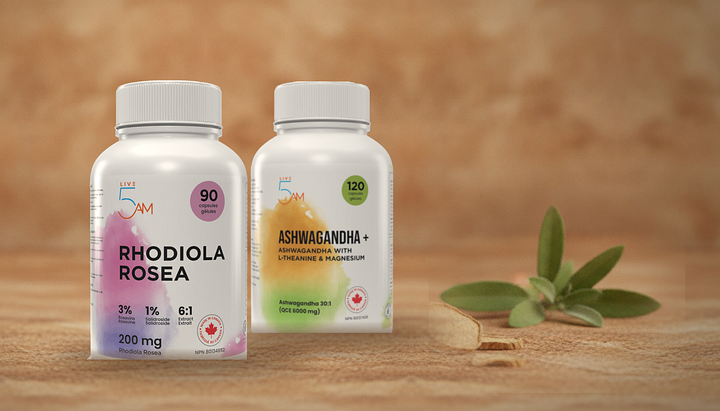
Our Rhodiola Rosea 200 mg is a 6:1 root extract standardized to 3% rosavins and 1% salidroside, licensed under NPN 80134852, taken as one capsule once or twice daily. I went with 200 mg per capsule rather than a higher dose because it matches the monograph's single-dose cap exactly, the evidence for daily use at that level is solid, it tends to be well tolerated, and it leaves room for people who want to assess their response before deciding whether to adjust. It is a single-ingredient capsule with no fillers that don't need to be there, and we use a generic standardized extract rather than a branded one.
What the licence actually permits us to say is narrower than most marketing: it helps temporarily relieve symptoms of stress such as mental fatigue and sensation of weakness, and it helps support cognitive function such as mental focus and mental stamina. We don't claim it treats anything, because no NPN-licensed product is permitted to. That's the honest version of what it does.
Yes, but with some caution, especially when starting out. Both rhodiola and caffeine can have a mildly activating effect, and for some people the combination amplifies that more than expected. A reasonable approach is to take rhodiola first, wait 20 to 30 minutes, then have your coffee with breakfast. If you find you feel wired or anxious, try spacing them further apart or reducing your coffee intake temporarily while you establish your baseline response to rhodiola on its own.
It varies. Some people report noticing something within the first few days, particularly around mental clarity or a calmer response to stressful situations. For others, it takes three to four weeks of consistent daily use before anything becomes apparent. The research on acute use suggests some effects can appear relatively quickly, but the fuller picture of how rhodiola supports resilience tends to emerge with sustained use over several weeks. The practical advice is to commit to at least a month before evaluating whether it's doing anything for you.
Health Canada's monograph permits 144 to 680 mg of standardized extract per day, with no more than 200 mg in any single dose, and directs against taking it before bedtime. Most NPN-licensed capsule products sit between 200 and 400 mg daily, taken as one or two capsules earlier in the day.
Most research on rhodiola has been conducted with daily use over periods of several weeks to a few months, and daily use at licensed doses appears well tolerated for most adults. Cycling (taking a break of one to two weeks after every six to eight weeks of use) is a common approach in adaptogen protocols. The label carries a hard contraindication for bipolar disorder or bipolar spectrum disorder, and cautions for pregnancy, breastfeeding, antidepressant medication, hormone replacement therapy and birth control medication. Stop use if you experience irritability or insomnia.
I'd steer away from evening use if you can. Every licensed Canadian rhodiola label directs against taking it before bedtime, because its gently activating profile can interfere with sleep. If mornings genuinely don't work, early afternoon (before 2 pm) is a better fallback than evening.
Rhodiola is one of the more straightforward adaptogens to use once you understand its character: it's an herb for the morning, not the evening; it works better on an empty stomach; and it rewards consistency over several weeks rather than delivering dramatic results in a day or two. In Canada the licensed range is 144 to 680 mg of standardized extract per day, capped at 200 mg per single dose. Start at the lower end, take it early, and give it enough time before deciding whether it belongs in your routine.
Before you start, read the caution section above properly. The bipolar contraindication in particular is a genuine one, not boilerplate.
This article is for informational purposes only and does not constitute medical advice. Rhodiola supplements are not intended to diagnose, treat, cure, or prevent any disease or health condition. Individual results vary. Consult a qualified health care practitioner before starting any new supplement, particularly if you are pregnant, breastfeeding, taking prescription medication, or managing a diagnosed health condition, including bipolar disorder.
Related reading: Rhodiola vs Ashwagandha: How to Choose the Right Adaptogen · Rhodiola Canada: What to Look For Before You Buy · Should You Cycle Adaptogens? What the Evidence Says · Can You Take Ashwagandha and Rhodiola Together? · Rhodiola Rosea 200 mg
About the Author
Mansour Norouzi is the founder of Live 5AM, a Toronto-based, NPN-licensed supplement brand. He works hands-on with Health Canada-licensed natural health products and writes about supplement science, adaptogens, and longevity ingredients. Every Live 5AM product carries a Natural Product Number (NPN), meaning its ingredients, doses, and claims have been reviewed by Health Canada.

Adaptogen for stress resilience and cognitive support.