NAD+ Boosters in Canada: What the Licence Lets Each Ingredient Claim
Comparison of Prices, Services & Prescribing Standards Finals


Free shipping on all orders
30-Day Guarantee
Comparison of Prices, Services & Prescribing Standards Finals

With any NAD+ product, including ours, the first thing I read is the wording on the licence: what Health Canada lets each ingredient say, and what it does not. This post walks through the Live 5AM NAD+ Booster Complex licence the way I read it, so you can read any NAD+ product the same way. It is not medical advice, and a practitioner is the right person to ask if you are pregnant, breastfeeding or have a health condition.
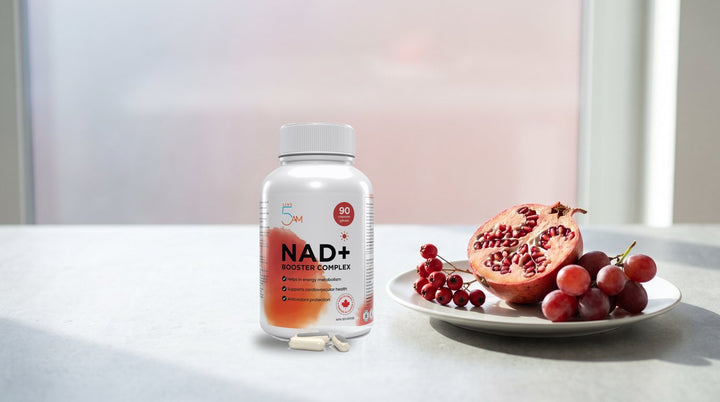
In Canada, an NAD+ booster can only claim what its licence lists, and the licence lists claims for the product as a whole. Nicotinamide riboside is licensed as a source of vitamin B3 that helps maintain blood NAD+ levels, hawthorn carries a traditional cardiovascular wording, and the other ingredients fall under general antioxidant language. Live 5AM NAD+ Booster Complex (NPN 80145698) follows that licence line by line.
The Health Canada record for NPN 80145698 lists six medicinal ingredients per capsule: 100 mg of nicotinamide riboside (as nicotinamide riboside chloride), 100 mg of trans-resveratrol, 100 mg of quercetin, 100 mg of grape seed extract standardized to 85% oligomeric proanthocyanidins (OPCs), 50 mg of a 10:1 hawthorn fruit extract and 50 mg of a 10:1 pomegranate extract. The directions for adults 18 and over are one capsule, three times daily.
Two details matter right away. First, this is a nicotinamide riboside (NR) product, not an NMN product. They are different molecules with different licences, and our post on NMN vs NR vs NAD+ booster covers the difference. Second, the licence is the ceiling. Anything a brand says beyond it is marketing, not authorization. If you want to check any number yourself, our guide to verifying a supplement NPN in Canada shows how.
The B3 wording is the most specific in the record. The licence supports statements that the product is a source of vitamin B3, which supports biological functions that play a key role in the maintenance of good health, and which helps to maintain blood NAD+ levels to support cellular health. It also carries general lines on energy metabolism and tissue formation, and on the body's ability to metabolize nutrients.
Notice what is not there. The licence does not say the product raises NAD+ to youthful levels, slows aging, or improves energy on any timeline. "Helps maintain blood NAD+ levels" is a narrower and more careful statement than the hype around NAD+ suggests, and I think that is the right size for it.
Less than you might expect. In the public record, claims are listed for the product as a whole rather than ingredient by ingredient. For these four, the relevant wording is general antioxidant language: the product is a source of antioxidants that help protect cells against the oxidative damage caused by free radicals.
That means phrases such as "activates sirtuins" or "senolytic" are research vocabulary from the lab literature, not licence language. They describe hypotheses and cell or animal findings, and a Canadian label cannot use them to make a product claim. Resveratrol is also the ingredient that triggers a specific caution on the licence, which brings us to the cautions below.
Hawthorn is the one botanical in the formula with its own named line. The licence states that Crataegus laevigata is traditionally used in Herbal Medicine to help maintain and/or support cardiovascular health in adults. The word "traditionally" is deliberate: it signals a claim based on a long history of use rather than modern clinical trials, and Health Canada recognizes those claims as a distinct category.
This is a good example of why reading the exact words matters. "Supports cardiovascular health" sounds like a modern outcome claim. "Traditionally used in Herbal Medicine to help maintain and/or support" tells you the basis of the claim is tradition.
The best human data in this formula is for nicotinamide riboside. In a placebo-controlled crossover trial in healthy middle-aged and older adults, 1,000 mg per day of NR for six weeks was well tolerated and was associated with higher NAD+ metabolism. In a separate crossover trial of 12 older men, 1 g per day for 21 days raised the muscle NAD+ metabolome and lowered some circulating inflammatory markers, without changing mitochondrial energy production.
The licensed dose of this product is 100 mg of NR three times a day, or 300 mg per day, about a third of the daily amount used in those trials. The studies also used NR on its own, not inside a six-ingredient formula, and they were short and small. Research suggests NR can raise NAD+ metabolites. Whether that translates into outcomes you would notice is still an open question, and the licence wisely does not claim it does.
Also read the cautions, which are part of the licence. For this product they include asking a health care practitioner before use if you are pregnant or breastfeeding, and before combining it with other medications or health products, because resveratrol may alter their effectiveness. The full caution panel is on the bottle and in the database record, and it is worth reading in full.
The licensed directions for Live 5AM NAD+ Booster Complex are one capsule, three times daily, for adults 18 and over. The licence does not set specific clock times, so the practical approach is to space the three capsules across your day in a pattern you will actually repeat. If you want the full ingredient-by-ingredient walkthrough, see the science behind NAD+ Booster Complex, and for a market overview see NAD+ Supplement Canada: What to Look For.
Only what its Health Canada licence lists. For a nicotinamide riboside product that typically means source-of-vitamin-B3 wording, such as helping to maintain blood NAD+ levels to support cellular health, plus any general or traditional claims for the other ingredients.
No. Both are vitamin B3 forms that the body can use to make NAD+, but they are different molecules with different licences. A licence for one does not authorize claims for the other.
No. The NAD+ wording in this licence is tied to the vitamin B3 source. Resveratrol, quercetin, grape seed and pomegranate fall under general antioxidant language.
It means the claim rests on a history of traditional use rather than on modern clinical trials. Health Canada accepts these claims in a distinct category, and the exact wording matters.
Search the Licensed Natural Health Products Database for the eight-digit NPN on the bottle. The record lists each medicinal ingredient and quantity, the licensed uses, the directions and the cautions.
NAD+ is a topic where the marketing runs well ahead of the evidence, and the Canadian licence is a useful anchor because it is conservative. It lets nicotinamide riboside say it helps maintain blood NAD+ levels, lets hawthorn say it is traditionally used for cardiovascular health, and gives the rest general antioxidant wording.
When you compare products, compare licences, doses and wording, not slogans. That is the standard I hold Live 5AM to.
This article is for informational purposes only and is not medical advice. Supplement licences and database records change, so always verify the current record with Health Canada. Speak with a health care practitioner or pharmacist before starting a supplement, especially if you are pregnant, breastfeeding or taking any medication.
About the Author
Mansour Norouzi is the founder of Live 5AM, a Health Canada NPN-licensed supplement brand based in Toronto. He personally reviews every article published here. Questions or corrections: info@live5am.com

6-in-1 NAD+ formula. Supports cellular health, energy metabolism and antioxidant protection.