Ashwagandha in Canada: How to Read the Withanolide Number on the Label
Comparison of Prices, Services & Prescribing Standards Finals


Free shipping on all orders
30-Day Guarantee
Comparison of Prices, Services & Prescribing Standards Finals

"What percent withanolides is yours?" is a question that comes up a lot when people compare ashwagandha products. It is a fair question, and the honest answer starts with what a Canadian licence does and does not record. This is not medical advice, and if you are pregnant or breastfeeding, please speak with a health care practitioner before using any ashwagandha product.
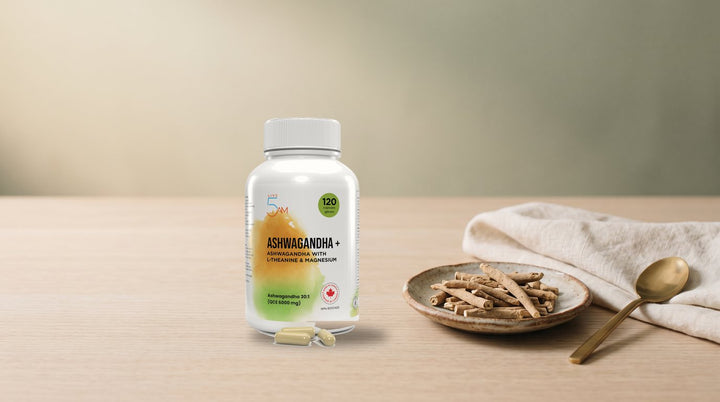
A ratio like 30:1 tells you how much raw root went into making the extract. The withanolide percentage tells you how much of the herb's signature active group is in it. An NPN confirms the ingredient, dose and permitted claims, but only shows a withanolide figure if the licence lists one. Live 5AM Ashwagandha+ (NPN 80137426) is licensed as a 30:1 root extract at 200 mg.
An extract ratio describes how much dried herb was used to make one unit of extract. A 30:1 extract means roughly 30 parts of dried ashwagandha root were concentrated into 1 part of extract. Health Canada licence records capture this as a ratio plus a "dried herb equivalent" (DHE). On the Live 5AM Ashwagandha+ licence, 200 mg of 30:1 dry root extract is recorded with a DHE of 6,000 mg.
That is useful, but it is a statement about how the extract was made, not about what is inside it. Two 30:1 extracts can contain very different amounts of withanolides, because the ratio does not say which part of the root was used, how it was extracted, or what was left behind. Think of it like coffee: knowing how many beans went into a concentrate does not tell you the caffeine content of the cup.
Withanolides are a family of steroid-like compounds found in ashwagandha, and they are the group most often used to describe the herb's activity. A label that says "5% withanolides" is stating how much of the extract, by weight, is made up of those compounds. Commercial extracts vary widely, from low single digits to well over 30%, so the same 200 mg capsule can carry very different amounts depending on the material inside.
The percentage matters for one practical reason: it lets you compare two products on the same footing. Without it, a bigger milligram number on the front of a bottle may simply mean more filler or a weaker extract. With it, you can estimate the withanolide content per capsule (milligrams of extract multiplied by the percentage).
"Standardized" generally means the manufacturer tested the extract for a named marker compound and adjusted it to a target level. You may also see shorthand such as "QCE" on a label. On the Live 5AM Ashwagandha+ bottle the line reads "Ashwagandha 30:1 (QCE 6000 mg)". That 6,000 mg is the raw-root equivalent: 200 mg of a 30:1 extract is made from about 6,000 mg of dried root, which matches the dried herb equivalent in the licence record. So here QCE describes how much root went in, not how much withanolide came out.
QCE is a label term rather than a Health Canada licence field (the record uses a ratio and a dried herb equivalent, plus a separate potency field), so if you see it on another brand, check what the figure measures. The useful test is simple: a potency line should name the compound, the percentage, and ideally the testing method. If a label gives a marker percentage but no ratio, or a ratio but no marker, you are only seeing half the picture.
A Natural Product Number means Health Canada reviewed the product and issued a licence, and that the product is made at a licensed site. The licence fixes the medicinal ingredient, the quantity per dose, the directions, the permitted claims, and the cautions that must appear on the label. You can look up all of it for free in the Licensed Natural Health Products Database. For the basics of checking a number, see our guide to how to verify a supplement NPN in Canada.
What an NPN does not do is guarantee a withanolide percentage. If the licence has no potency entry for withanolides, then no particular withanolide level is part of what was authorized. That is true of the Live 5AM Ashwagandha+ licence: its record lists the 30:1 ratio and dose, with the potency fields blank. I would rather say that plainly than imply a number the licence does not state.
The licensed uses for this product include a herbal medicine adaptogen line, "to help increase energy and resistance to stress over time (e.g. in case of mental and physical fatigue related to stress)", and a line that it helps to temporarily promote relaxation. Neither claim names a withanolide level, a cortisol number, or a timeline in days.
This is where reading the number carefully pays off. In a 60-day trial of 60 stressed adults, 240 mg per day of a standardized ashwagandha root extract was associated with a larger drop in morning cortisol than placebo (P < .001) and a statistically significant reduction on the Hamilton Anxiety Rating Scale (P = .040). In a 60-day trial of 64 adults with a history of chronic stress, 300 mg twice daily (600 mg per day) of a full-spectrum root extract was associated with lower stress scores and lower serum cortisol than placebo. An eight-week trial of 58 completers compared 250 mg and 600 mg per day against placebo and reported improvements in perceived stress with both.
A 200 mg capsule sits at or below the low end of those daily amounts, and the trial extracts were different materials from any product on the shelf, so this is a reasonable question to ask, not a conclusion to draw. Trials of this size are also modest: they run 8 to 9 weeks, enrol dozens rather than thousands of people, and use extracts whose withanolide content was specified by the manufacturer. Research suggests benefit is plausible, not guaranteed.
The licence for Live 5AM Ashwagandha+ directs one capsule daily for adults. Because the licence does not specify a time of day, the practical advice is consistency: choose a time you will actually repeat. Since drowsiness is listed as a possible effect, notice how you feel in the first few days before driving or operating machinery. If you want a realistic picture of timelines, our post on how long ashwagandha takes to work covers what trials measured, and our Ashwagandha Canada buyer's guide walks through the wider market.
It means about 30 parts of dried root were used to make 1 part of extract. It describes how concentrated the extract is relative to the raw herb, not how much withanolide it contains. On a Health Canada licence it appears as a ratio alongside a dried herb equivalent.
Not automatically. A higher percentage shows a more concentrated marker, but the studies that exist were run on specific extracts at specific doses, and a higher number on a different extract has not been shown to work better. Use the percentage to compare products, and the licence to understand what is actually claimed.
No. An NPN confirms what Health Canada authorized, including the ingredient, dose and claims. A withanolide level is only part of that authorization if the licence lists it as a potency, so check the record rather than assuming.
Search the Licensed Natural Health Products Database by the eight-digit NPN on the bottle. The record shows the medicinal ingredients with their quantity and ratio, any potency listed, the licensed uses, the directions and the cautions.
The trials cited here ran 60 days to 8 weeks, so a few days is not a fair test. Pick a consistent routine, keep notes, and review after several weeks, speaking with a practitioner if you have concerns.
A ratio tells you how the extract was made. A withanolide percentage tells you what is in it. A licence tells you what Health Canada authorized, which may or may not include that percentage. Read all three before comparing prices.
For Live 5AM Ashwagandha+, the licence gives a 30:1 root extract at 200 mg with L-theanine and magnesium, and claims about resistance to stress and relaxation. It does not give a withanolide number, and I would rather you know that than assume it.
This article is for informational purposes only and is not medical advice. Ashwagandha is not appropriate for everyone, and the Live 5AM licence advises asking a health care practitioner before use if you are pregnant or breastfeeding. Speak with a practitioner before starting a supplement, and always verify the current licence record on Health Canada's database.
About the Author
Mansour Norouzi is the founder of Live 5AM, a Health Canada NPN-licensed supplement brand based in Toronto. He personally reviews every article published here. Questions or corrections: info@live5am.com

Helps support resistance to stress. Used in Herbal Medicine