Ashwagandha Canada: An NPN Buyer's Guide
Comparison of Prices, Services & Prescribing Standards Finals


Free shipping on all orders
30-Day Guarantee
Comparison of Prices, Services & Prescribing Standards Finals

I get asked about ashwagandha more than almost any other ingredient we sell at Live 5AM, usually by someone who has already read three different blog posts with three different opinions. Most of that confusion comes from people mixing up US supplement marketing with what is actually licensed and reviewed here in Canada. So I want to walk through what an NPN means for an ashwagandha product, what the label should actually say, and what the research does and does not support, without the hype.
In Canada, start with the NPN, the eight-digit number confirming Health Canada has reviewed the product's ingredients, dose, and claims before it went to market. Beyond that, look for a standardized root extract (not leaf powder or a vague "whole plant" blend), a disclosed extraction ratio or withanolide percentage, a daily dose that lines up with clinical research (roughly 300 to 600 mg of standardized extract), and label claims limited to what Health Canada's own ashwagandha monograph actually authorizes.
An NPN (Natural Product Number) is the licence Health Canada's Natural and Non-prescription Health Products Directorate (NNHPD) issues after reviewing a natural health product for safety, efficacy, and quality. For ashwagandha specifically, that review is anchored to a public reference document: the Health Canada NHPID monograph for Withania somnifera, last updated February 2025. Every ashwagandha NPN application is assessed against that monograph's approved source material, dose ranges, and claim language, or against separate clinical evidence the applicant submits directly.
Practically, an NPN on the label tells you three things: the ingredient and dose match what is on the licence, the claims printed on the bottle were reviewed (a brand cannot legally print a claim Health Canada has not approved), and the manufacturer meets Good Manufacturing Practice standards. A product sold into Canada without an NPN, which includes a lot of US-brand ashwagandha shipped north or sold through Amazon.ca by unlicensed sellers, has not gone through this review for the Canadian market. You can verify any NPN yourself in Health Canada's Licensed Natural Health Products Database (LNHPD) by entering the eight-digit number.
Health Canada's ashwagandha monograph specifies two acceptable source materials: the root, or the whole plant. It does not authorize leaf-only extracts under the standard monograph pathway. This matters because root and leaf have different chemical profiles. The root is the traditionally used part in Ayurveda and carries the withanolide and alkaloid mix that the clinical trial evidence is built on. Leaf extracts, sometimes marketed under proprietary names for higher withanolide concentration, have a thinner human safety and efficacy record and sit outside the generic monograph most NPN-licensed Canadian products rely on.
When you read a Canadian label, look for the source material named directly: "Withania somnifera root extract" or "root/whole plant." If a label just says "ashwagandha extract" with no plant part specified, that is a gap worth asking about, not necessarily a dealbreaker, but a reason to check the LNHPD listing for the specific NPN before buying.
A standardized extract means the manufacturer has tested the raw material and adjusted or verified it to hit a consistent target, most commonly an extraction ratio (such as 15:1 or 30:1, meaning 15 or 30 kg of raw root reduced to 1 kg of extract) or a withanolide percentage confirmed by lab testing (commonly around 5%). The landmark 2012 clinical trial by Chandrasekhar and colleagues, published in the Indian Journal of Psychological Medicine, used a root extract standardized to a minimum 5% withanolide content by HPLC testing, dosed at 300 mg twice daily for 60 days.
The number itself matters less than the fact that a number exists at all. "Ashwagandha root powder, 500 mg" tells you the raw material weight, not the concentration of active compounds inside it. "Ashwagandha root extract, 15:1, standardized to 5% withanolides" tells you the manufacturer tested for potency. This is also where third-party testing earns its keep: ashwagandha is a root crop, and root crops can concentrate heavy metals from soil. A certificate of analysis covering both potency and contaminant screening is a reasonable thing to ask a Canadian brand for, and a licensed NPN product has already had its specifications reviewed as part of the manufacturing standards Health Canada requires. For a closer look at reading the withanolide line on a Canadian label, see ashwagandha withanolide labels in Canada.
This is where a lot of marketing overreaches. Health Canada's monograph authorizes a specific set of claims for ashwagandha, and the modern (non-Ayurvedic) claim most brands lean on is: "used in Herbal Medicine as an adaptogen to help increase energy and resistance to stress over time (e.g., in case of mental and physical fatigue related to stress)." That is deliberately hedged language, built around traditional use and mechanism, not a promise of a specific clinical outcome.
The monograph also authorizes several traditional Ayurvedic claims when the source material and preparation match, including use as a Rasayana (rejuvenative tonic), for memory enhancement, to help relieve restlessness or nervousness (which may help promote sleep), and to help relieve general debility. What the monograph does not authorize, and what no NPN-licensed ashwagandha product in Canada is permitted to say, is anything framed around a diagnosed medical condition or a guaranteed medical outcome. "Helps support resistance to stress" stays inside the licence. Language promising relief from an anxiety disorder or a mood disorder does not, and if you see that kind of language on a Canadian listing, it is a signal the product is not staying inside its own licence.
Health Canada's monograph lists two dosing pathways. For the traditional, non-standardized preparation (dried root, powdered, tincture, or similar), the range is 2 to 6.5 grams of dried root or whole plant per day, taken as a decoction, infusion, or dry extract. For standardized root extract products used under the "adaptogen" claim, the monograph range is 2.5 to 6.5 grams of dried root/whole plant equivalent per day, which in a concentrated extract translates to a much smaller capsule weight.
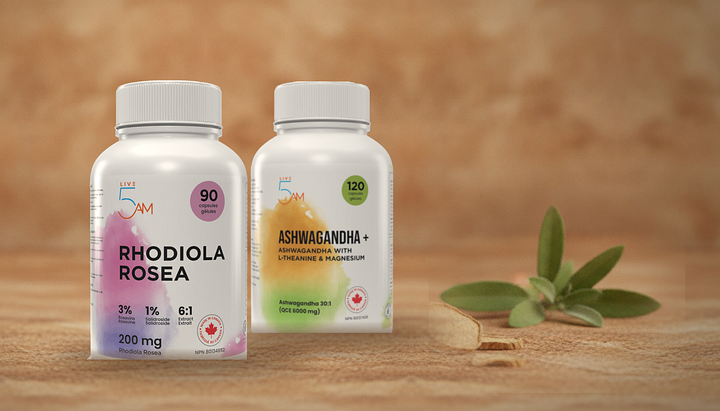
In practice, most NPN-licensed capsule products land between 300 and 600 mg of a concentrated standardized extract per day, which is also the range used in the strongest human trials. As one real example, Live 5AM's own Ashwagandha+ (NPN 80137426) uses 200 mg of a 30:1 root extract per capsule (a 6,000 mg dried herb equivalent), one capsule daily, alongside L-theanine and magnesium bisglycinate. The dose that matters is the one printed on the specific NPN you are looking at, since Health Canada reviews each formulation's dose against its own supporting evidence rather than applying one number catalogue-wide.
Health Canada's monograph requires two cautions on every licensed ashwagandha product: consult a health care practitioner before use if you are pregnant or breastfeeding, and use caution when driving or operating machinery, since some people experience drowsiness. Beyond what is printed on the label, a few groups deserve an extra conversation with a pharmacist or doctor before starting: people with thyroid conditions (ashwagandha may raise thyroid hormone levels, and case reports describe symptomatic thyrotoxicosis in people combining it with thyroid medication), people with autoimmune conditions such as lupus, rheumatoid arthritis, or MS (it may stimulate immune activity), and anyone taking sedatives, thyroid medication, or blood pressure medication, since interactions are plausible even where the human evidence is still limited.
None of this makes ashwagandha unsafe for the general adult population at licensed doses. It means the same thing every NPN caution means: talk to a professional if your situation isn't the healthy-adult baseline the clinical trials were built around.
Ashwagandha is one of the few adaptogens where the clinical trial evidence and the traditional use point in the same direction: consistent daily use, not occasional dosing, is what the research actually measured. The Chandrasekhar trial ran 60 days before showing its cortisol and stress-scale results, and most of the newer trials follow a similar eight-to-twelve-week window. That points toward evening use for most people, since the traditional framing (and the drowsiness caution on the label) fits a wind-down routine better than a morning stack built around alertness.
Our Ashwagandha+ is built around that pattern: a standardized root extract at a licensed 200 mg (30:1) dose, paired with L-theanine and magnesium bisglycinate, taken once daily. It carries NPN 80137426, licensed to NorthMED Life Sciences Inc., with the "used in Herbal Medicine as an adaptogen to help increase energy and resistance to stress over time" claim on the label, exactly as Health Canada's monograph permits. If you are also using other Live 5AM products, an evening ashwagandha capsule pairs naturally with a magnesium product taken at the same time, while anything intended for daytime energy or focus belongs earlier in the day.
Yes, as a licensed natural health product with a valid NPN. Health Canada maintains a public monograph for Withania somnifera that lays out the approved source material, dose ranges, and claim language a product must match to be licensed. Products sold in Canada without an NPN, including some US-brand ashwagandha shipped north, have not been reviewed against that monograph for the Canadian market and are not authorized to make natural health product claims here.
Start with the NPN itself, then check that the source material is named as root or whole plant, that the extract is standardized (an extraction ratio like 15:1 or 30:1, or a withanolide percentage), and that the dose is stated clearly per capsule and per day. The approved claim language should read something close to "used in Herbal Medicine as an adaptogen to help increase energy and resistance to stress over time." Anything promising to treat, cure, or prevent a diagnosed condition is outside what an NPN licence permits.
Most licensed capsule products use 300 to 600 mg of a concentrated, standardized root extract per day, which matches the range used in the strongest clinical trials, including the widely cited Chandrasekhar et al. (2012) study at 600 mg per day (300 mg twice daily). Health Canada's monograph also permits a traditional dosing pathway of 2 to 6.5 grams of dried root or whole plant per day for non-standardized preparations. The exact dose always depends on the specific NPN and extract ratio, which is printed on the label.
Ashwagandha is not licensed in Canada to treat, diagnose, or manage clinically diagnosed anxiety or depression, and no NPN-licensed product is permitted to make that claim. The Health Canada-approved claim relates to general stress resistance and energy, described as "helps increase energy and resistance to stress over time." If you have a diagnosed mental health condition, that is a conversation for a physician or mental health professional, not a supplement label. Some of the same research showing stress-scale improvements in healthy stressed adults is what supports the licensed adaptogen claim, but that is a different thing from treating a diagnosed disorder.
At doses matching a valid NPN licence, ashwagandha has a reasonable safety record in healthy adults, including a recent 12-month observational safety study on standardized root extract. Health Canada requires a caution about drowsiness (avoid driving or operating machinery if affected) and a caution for pregnancy and breastfeeding on every licensed label. People with thyroid conditions, autoimmune conditions, or those on sedative or thyroid medication should speak with a health care practitioner before starting, since ashwagandha may interact with thyroid hormone levels and immune activity in ways that are still being actively studied.
Ashwagandha has one of the better-supported evidence bases of any adaptogen sold in Canada, and Health Canada has built a real regulatory framework around it, not just a loophole. That framework is your shortcut: an NPN means the source material, dose, and claims on the label have already been checked against the monograph or against submitted clinical evidence. Look for the number first.
From there, the details that separate a well-made product from a filler one are the same details Health Canada's own monograph cares about: root (not leaf), a standardized extract with a disclosed ratio or withanolide percentage, and a dose in the range the clinical trials actually used. Be skeptical of any Canadian listing making claims beyond "helps support resistance to stress" or the traditional Ayurvedic uses, since those are the only claims a licensed ashwagandha product is permitted to carry.
If you are new to the ingredient, start with a single, standardized-extract product at a licensed dose, give it the eight to twelve weeks the research actually studied, and check in with a health care practitioner first if you have a thyroid condition, an autoimmune condition, or are on medication that could interact.
This article is for informational purposes only and does not constitute medical advice. Ashwagandha supplements are not intended to diagnose, treat, cure, or prevent any disease or health condition. Individual results vary. Consult a qualified health care practitioner before starting any new supplement, particularly if you are pregnant, breastfeeding, taking prescription medication, or managing a chronic health condition, including thyroid or autoimmune conditions.
About the Author
Mansour Norouzi is the founder of Live 5AM, a Toronto-based, NPN-licensed supplement brand. He works hands-on with Health Canada-licensed natural health products and writes about supplement science, adaptogens, and longevity ingredients. Every Live 5AM product carries a Natural Product Number (NPN), meaning its ingredients, doses, and claims have been reviewed by Health Canada.

Helps support resistance to stress. Used in Herbal Medicine