Pomegranate and Urolithin A: The Mitochondrial Connection
Comparison of Prices, Services & Prescribing Standards Finals


Free shipping on all orders
30-Day Guarantee
Comparison of Prices, Services & Prescribing Standards Finals

I get asked a version of this question every time we talk about the NAD+ Booster formula: why is pomegranate in a mitochondrial health product at all? It's not an obvious pairing until you look at what pomegranate actually does in the gut. I'm Mansour, founder of Live 5AM, and this one took me down a research rabbit hole I want to walk you through honestly, including the part where the science is still catching up to the marketing.
Urolithin A is a compound your gut bacteria produce when they break down ellagitannins and punicalagins, the polyphenols concentrated in pomegranate. Once formed, urolithin A is studied for its role in mitophagy, the process that clears out damaged mitochondria. Not everyone converts pomegranate compounds into urolithin A at the same rate; conversion depends heavily on individual gut microbiome composition.
Urolithin A doesn't exist in pomegranate itself. It's a metabolite, created inside your body rather than eaten directly, and it's one of the more biologically active compounds to emerge from the breakdown of ellagitannins, a class of large polyphenols found in pomegranate, walnuts, and certain berries. What made it notable was its behavior in mitochondria, the structures inside cells that generate energy. Preclinical and early human research suggests urolithin A can support the process by which cells recycle worn-out mitochondria, called mitophagy. That's a specific and fairly new area of nutrition science, and it's why urolithin A has moved from an obscure gut metabolite to a name showing up in longevity and sports nutrition research.
Pomegranate, particularly the seed and aril, is rich in punicalagins and ellagitannins, large polyphenols that are not well absorbed in their original form. Instead, they travel largely intact into the colon, where resident gut bacteria break them down in stages. The end product of that bacterial conversion is urolithin A, along with related compounds like urolithin B. This is different from how most nutrients work: you're not absorbing a vitamin directly, you're feeding a substrate to your microbiome and hoping the right bacterial species are present to finish the job. That dependency on gut bacteria is the single most important thing to understand about this pathway, and it's why the pomegranate-to-urolithin-A story isn't as simple as "eat pomegranate, get urolithin A."
Mitochondria are constantly working and, like any hardworking machinery, they accumulate damage over time. Mitophagy is the quality-control system that identifies damaged mitochondria and clears them out so they can be replaced with functional ones. One of the best-characterized routes is the PINK1/Parkin signaling pathway, where a build-up of PINK1 protein on a damaged mitochondrion flags it for removal. A 2022 randomized, placebo-controlled trial in older adults (Liu et al., JAMA Network Open) found urolithin A supplementation was associated with improved muscle endurance, and muscle biopsy analysis showed increased markers of mitochondrial and mitophagy activity, including the active form of Parkin. It's one of the more direct pieces of human evidence linking urolithin A intake to mitophagy markers, though the field is still early and most mechanistic detail comes from cell and animal studies.
This is the part that rarely makes it into marketing copy. Human studies group people into urolithin "metabotypes": UM-A (efficient producers), UM-B (partial producers, who also make related compounds), and UM-0 (non-producers, who make little to none). Population studies of healthy adults have found that only around 30-40% of people are efficient urolithin A producers from dietary sources like pomegranate; the rest produce smaller amounts, different urolithin variants, or none at all. Producer status appears linked to the diversity and composition of a person's gut microbiome, specifically the presence of bacterial species capable of the multi-step reaction required to build urolithin A from its ellagitannin precursors. There's no simple at-home test for this in Canada, so most people don't know which category they fall into.
Yes. Even setting the urolithin A pathway aside, pomegranate's punicalagins and ellagitannins are potent antioxidants in their own right before any bacterial conversion happens. A 2024 review of punicalagin's bioactive potential and a 2025 randomized trial in older adults (Farhat et al., Geriatrics) both point to measurable antioxidant activity from pomegranate extract independent of urolithin A status. The direct antioxidant contribution, protecting cells against oxidative damage caused by free radicals, applies to anyone who takes pomegranate, regardless of their microbiome's ability to finish the urolithin A conversion. The mitophagy story is the more novel layer, but it's a bonus that varies person to person, not the only thing pomegranate is doing.
Because of the producer-variability problem, some companies now sell purified urolithin A directly rather than relying on pomegranate and gut bacteria to make it. A 2022 pharmacokinetic study (Singh et al., European Journal of Clinical Nutrition) found direct urolithin A supplementation produced consistent blood levels across study participants regardless of natural producer status, essentially bypassing the microbiome bottleneck, a real advantage if urolithin A exposure is the specific goal. Whole pomegranate extract takes a different approach: it delivers ellagitannins and punicalagins as a food-based antioxidant source, with urolithin A conversion as a downstream, variable bonus. Neither approach is right or wrong; they solve slightly different problems, and it's worth knowing which one you're actually getting.
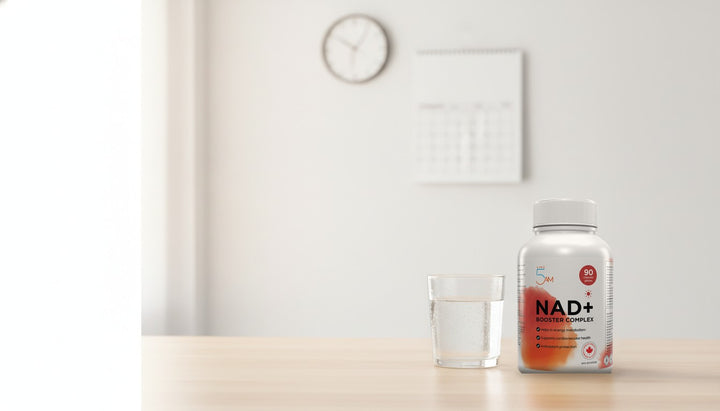
Pomegranate extract (a standardized 10:1 extract) is one of six ingredients in our NAD+ Booster Complex, alongside nicotinamide riboside, resveratrol, quercetin, grape seed extract, and hawthorn. We didn't add it because urolithin A is guaranteed for every person who takes it. We added it because pomegranate's antioxidant contribution is well-supported regardless of individual gut microbiome, and the mitophagy angle is a scientifically interesting layer on top for those who happen to convert it well. It's formulated as part of a broader mitochondrial and cellular health approach rather than a single-ingredient bet, consistent with how we think about the rest of the Daily Pace lineup: pairing ingredients with different, complementary mechanisms rather than stacking multiples of the same one.
It can, but only in people whose gut microbiome includes the bacterial species capable of completing the conversion. Research suggests roughly 30-40% of people are efficient producers; others convert partially or not at all, even with consistent pomegranate intake.
There's no widely available consumer test for this in Canada right now. Researchers typically classify people into metabotypes (UM-A, UM-B, UM-0) using specialized lab analysis of urine or blood after a controlled pomegranate dose, which isn't practical outside a research setting.
Only if your gut bacteria are able to convert the ellagitannins in the juice, and studies show that conversion rate and efficiency vary widely between individuals. Pomegranate juice and extract still provide direct antioxidant polyphenols either way.
Published human trials using both pomegranate-derived polyphenols and purified urolithin A have generally reported it as well tolerated at studied doses. As with any supplement, check with a health care practitioner before starting, especially if you take other medications or have an underlying health condition.
Pomegranate delivers ellagitannins and punicalagins as food-based antioxidants, with urolithin A as a variable, microbiome-dependent bonus. Purified urolithin A supplements skip that variability by providing the compound directly, which research shows produces more consistent blood levels across different people.
Pomegranate's connection to urolithin A is one of the more genuinely interesting stories in current nutrition research, but it's also a good case study in why supplement claims need a hedge attached. The gut bacteria conversion step means pomegranate cannot guarantee a urolithin A dose for everyone, and the honest number, roughly 30-40% of people being efficient producers, deserves more airtime than it usually gets.
What pomegranate can reliably offer, independent of anyone's microbiome, is antioxidant support from its punicalagin and ellagitannin content, the basis for the Health Canada-approved antioxidant claim on our label. The mitophagy research is promising and growing quickly, but most of the strongest human data so far comes from studies using purified urolithin A rather than whole pomegranate extract.
That's why pomegranate is one piece of a six-ingredient formula rather than the headline ingredient: a well-evidenced antioxidant contributor with a promising, still-emerging mitochondrial angle layered on top.
This article is for educational purposes and is not medical advice. It does not diagnose, treat, cure, or prevent any disease. Speak with a health care practitioner before starting any new supplement, especially if you are pregnant, breastfeeding, or taking medication.
About the Author
Mansour Norouzi is the founder of Live 5AM, a Toronto-based, NPN-licensed supplement brand. He works hands-on with Health Canada-licensed natural health products and writes about supplement science, adaptogens, and longevity ingredients. Every Live 5AM product carries a Natural Product Number (NPN), meaning its ingredients, doses, and claims have been reviewed by Health Canada.

6-in-1 NAD+ formula. Supports cellular health, energy metabolism and antioxidant protection.