Rhodiola Canada: What to Look For Before You Buy
Comparison of Prices, Services & Prescribing Standards Finals


Free shipping on all orders
30-Day Guarantee
Comparison of Prices, Services & Prescribing Standards Finals

Rhodiola is the ingredient I get the most mixed messages about, energy seekers, people who've read it helps with anxiety, and people confusing it with a different adaptogen entirely. At Live 5AM I keep two things separate: what the research on Rhodiola rosea actually shows, and what Health Canada actually lets a licensed Canadian label say. Here's what I'd want a friend to know before buying a bottle.
Look for the NPN first, the eight-digit number confirming Health Canada reviewed the product's ingredients, dose, and claims before it reached shelves. From there, confirm the label specifies Rhodiola rosea by name (not just "rhodiola"), that the source is root or root and rhizome, that the extract is standardized to roughly 3% rosavins and 1% salidroside, and that the daily dose sits inside Health Canada's monograph range. The claim language should read close to "helps temporarily relieve symptoms of stress such as mental fatigue and sensation of weakness," not a promise to treat anxiety or depression.
An NPN (Natural Product Number) is issued by Health Canada after a product's ingredients, dose, and claims have been reviewed for safety and quality, and for rhodiola that review is measured against the Health Canada NHPID monograph for Rhodiola rosea, last updated October 31, 2025. A valid NPN means the ingredient and dose match what was licensed, and the claims on the label were reviewed rather than written freehand by a marketing team. Rhodiola sold in Canada without an NPN, including a fair amount of US-brand product shipped north, hasn't gone through that review. Check any NPN in Health Canada's Licensed Natural Health Products Database (LNHPD).
The genus Rhodiola includes roughly 200 species, but the clinical research base, and Health Canada's monograph, is built specifically around Rhodiola rosea (also labelled roseroot, king's-crown, or Hong jing tian). A label that just says "rhodiola extract" without naming the species is worth questioning, since other species carry a thinner safety and efficacy record. The monograph also specifies the acceptable plant parts, root or root and rhizome, prepared as a dry extract, since that's where the rosavin and salidroside content concentrates. Look for "Rhodiola rosea root" stated directly, not a vague "rhodiola blend."
Two compound groups carry most of the research signal: rosavins (found almost exclusively in Rhodiola rosea) and salidroside. Health Canada's monograph permits standardized extracts of 0.8 to 3% salidroside and/or 1 to 6% rosavins, and most landmark trials used a ratio close to 3% rosavins to 1% salidroside, an informal industry benchmark. A standardized extract usually carries a concentration ratio too, such as 6:1 (six kilograms of raw root reduced to one kilogram of extract), a sign the manufacturer actually tested potency rather than just grinding root. Rhodiola root has faced documented adulteration in the wider market with cheaper, low-rosavin material, so third-party testing verifying species and percentage is a fair ask of any Canadian brand.
Health Canada's monograph authorizes a specific set of claims. The one most Canadian labels lead with is: "helps temporarily relieve symptoms of stress, such as mental fatigue and sensation of weakness." Alongside that sits the adaptogen framing ("helps increase energy and resistance to stress over time"), a cognitive function claim, and a general antioxidant claim. What it does not authorize is any claim tied to a diagnosed mental health condition, and that matters more for rhodiola than most adaptogens, since some underlying research, including a widely cited six-week trial, studied people with a clinical diagnosis of mild to moderate depression. Real research, but not what an NPN label is permitted to print, and that gap is where marketing tends to overreach.
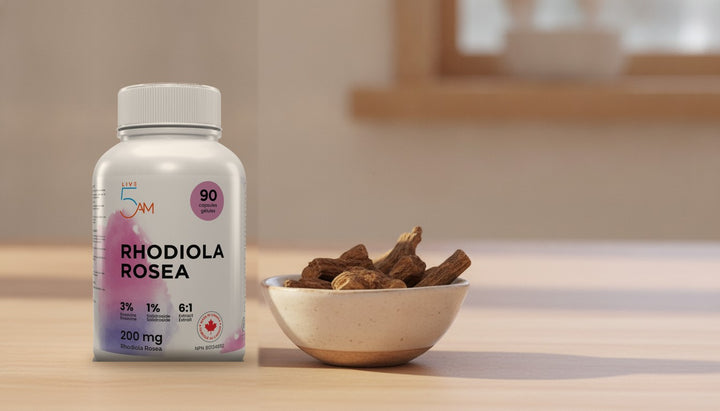
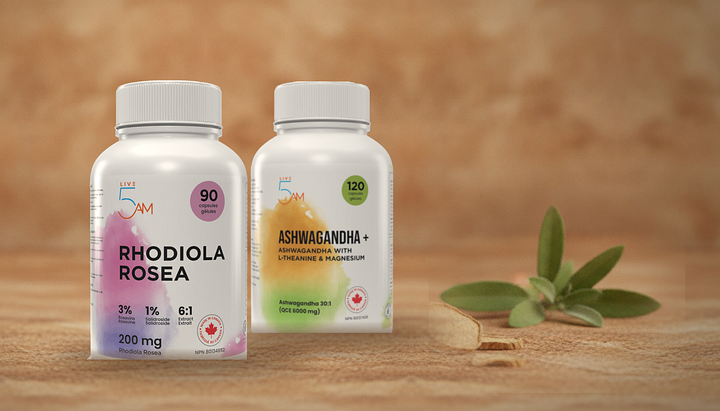
For the stress, adaptogen, and cognitive function claims, the monograph sets a standardized-extract range of 144 to 680 milligrams per day, capped at 200 milligrams per single dose, with an explicit direction to avoid taking rhodiola before bedtime. Most NPN-licensed capsule products land between 200 and 400 milligrams per day, taken as one or two capsules, which is exactly how Live 5AM's own Rhodiola Rosea (NPN 80134852) is dosed: 200 mg of a 6:1 root extract per capsule, standardized to 3% rosavins and 1% salidroside, one capsule once or twice daily. Rhodiola feels more stimulating than a slower-building adaptogen like ashwagandha, so most people land on a capsule in the morning, a second in the early afternoon if needed, and nothing in the evening.
The monograph carries a hard contraindication: do not use if you have bipolar disorder or bipolar spectrum disorder, since rhodiola's stimulating effect has been linked to manic or hypomanic episodes in that population. It also requires cautions to consult a health care practitioner before use if pregnant or breastfeeding, or if taking antidepressant medication, hormone replacement therapy, or birth control medication, plus a warning to stop use if you experience irritability or insomnia. None of this makes rhodiola unsuitable for a healthy adult taking it as directed; it just means reading the label and checking with a pharmacist or doctor if your situation falls outside that baseline.
Rhodiola's research leans toward shorter-term, situational use more than the slow-building daily pattern of something like ashwagandha, with trials on stress and mental fatigue showing effects within days to a few weeks. The "avoid before bedtime" direction on every licensed label reflects that rhodiola feels activating rather than calming, so it belongs earlier in the day, first thing in the morning or around midday when energy typically dips.
Our Rhodiola Rosea 200 mg is built around that pattern: a standardized 6:1 root extract at a licensed 200 mg dose, standardized to 3% rosavins and 1% salidroside, taken once or twice daily. It carries NPN 80134852, with the "helps temporarily relieve symptoms of stress such as mental fatigue and sensation of weakness" claim on the label, exactly as the monograph permits. Stacked with other Live 5AM products, a morning or midday rhodiola capsule pairs naturally with anything built for daytime focus, while anything meant for winding down belongs in the evening slot instead.
Yes, as a licensed natural health product with a valid NPN. Health Canada maintains a public monograph for Rhodiola rosea setting out the approved source material, dose ranges, and claim language a product must match. Rhodiola sold without an NPN, including some US-brand products shipped north, isn't authorized to carry natural health product claims here.
Start with the NPN, then confirm the species is named as Rhodiola rosea specifically, the source is root or root and rhizome, and the extract is standardized to around 3% rosavins and 1% salidroside. The claim language should read close to "helps temporarily relieve symptoms of stress such as mental fatigue and sensation of weakness." Anything promising to treat a diagnosed condition sits outside what an NPN licence permits.
Health Canada's monograph allows 144 to 680 milligrams of standardized extract per day, capped at 200 milligrams per single dose. Most licensed capsule products land between 200 and 400 milligrams per day, taken in the morning or early afternoon since the monograph directs against taking rhodiola before bedtime.
Rhodiola isn't licensed in Canada to treat, diagnose, or manage clinically diagnosed anxiety or depression, and no NPN-licensed product is permitted to make that claim. The Health Canada-approved claim is narrower: it "helps temporarily relieve symptoms of stress, such as mental fatigue and sensation of weakness." A diagnosed mental health condition is a conversation for a physician, not a supplement bottle.
At doses matching a valid NPN licence, rhodiola has a reasonable safety record, with a low rate of reported side effects across the trials Health Canada reviewed. The label carries a hard contraindication for bipolar disorder or bipolar spectrum disorder, a caution for pregnancy and breastfeeding, and a caution for anyone taking antidepressant medication, hormone replacement therapy, or birth control medication. Stop use if you notice irritability or insomnia, and avoid taking it close to bedtime.
Rhodiola has a genuine regulatory framework behind it in Canada, and that's your fastest filter: an NPN means the species, source material, dose, and claims on the label have already been checked against Health Canada's monograph. Start with the number, then check the same details the monograph cares about: Rhodiola rosea named specifically, root or root and rhizome as the source, a standardized extract around 3% rosavins and 1% salidroside, and a daily dose inside the 144 to 680 milligram range.
Be skeptical of any Canadian listing implying rhodiola can treat anxiety or depression, since that claim sits outside what any licensed product is permitted to carry, even where the underlying research is more encouraging. If you're new to rhodiola, take it earlier in the day, respect the bedtime caution, and check with a health care practitioner first if you have bipolar disorder, are pregnant or breastfeeding, or are taking antidepressant, hormone, or birth control medication.
This article is for informational purposes only and does not constitute medical advice. Rhodiola supplements are not intended to diagnose, treat, cure, or prevent any disease or health condition. Individual results vary. Consult a qualified health care practitioner before starting any new supplement, particularly if you are pregnant, breastfeeding, taking prescription medication, or managing a diagnosed health condition, including bipolar disorder.
About the Author
Mansour Norouzi is the founder of Live 5AM, a Toronto-based, NPN-licensed supplement brand. He works hands-on with Health Canada-licensed natural health products and writes about supplement science, adaptogens, and longevity ingredients. Every Live 5AM product carries a Natural Product Number (NPN), meaning its ingredients, doses, and claims have been reviewed by Health Canada.

Adaptogen for stress resilience and cognitive support.