Can You Take Ashwagandha and Rhodiola Together?
Comparison of Prices, Services & Prescribing Standards Finals


Free shipping on all orders
30-Day Guarantee
Comparison of Prices, Services & Prescribing Standards Finals

Customers ask me this constantly once they've settled into one adaptogen and start wondering about a second. Ashwagandha and rhodiola come up together more than any other pairing I hear about, and there's a reason for it: they tend to do different jobs. I'll walk through how I think about combining them and what the research actually supports. One note up front, since stress and mood are sensitive territory: this article is general education, not medical advice, and it isn't a substitute for talking with a healthcare practitioner about your own situation. Mansour, Live 5AM.
Yes. Ashwagandha and rhodiola are commonly paired because they cover different parts of the day: ashwagandha is typically used in the evening to help support resistance to stress, while rhodiola is typically used in the morning as an adaptogen to help temporarily relieve stress-related mental fatigue. Most people tolerate the combination well, but it's smart to start one at a time and check with a healthcare practitioner if you take medication.
Both plants fall under the broad "adaptogen" category, herbal ingredients traditionally used to help the body manage everyday stress, but they aren't interchangeable. Ashwagandha (Withania somnifera) is used in Herbal Medicine as an adaptogen to help support resistance to stress over time, alongside a traditional Ayurvedic use to help relieve restlessness and nervousness, which in turn helps promote sleep. Rhodiola (Rhodiola rosea), sometimes called golden root, is used in Herbal Medicine as an adaptogen to help temporarily relieve symptoms of stress such as mental fatigue and a sensation of weakness.
The logic behind stacking them isn't that one is stronger. It's that stress rarely shows up the same way at 7am and 9pm. Pairing ashwagandha and rhodiola covers both ends of a stressed-out day with ingredients built for different moments, rather than doubling up on the same effect.
Think of rhodiola as the more activating of the two. Its best-studied extract, SHR-5, has been tested at 170mg to 680mg per day in trials on stress-induced fatigue. In one frequently cited crossover study, 56 physicians on night duty who took a standardized rhodiola extract showed improvements on a fatigue index measuring attention, associative thinking, and short-term memory compared with placebo.
Ashwagandha leans calming and grounding. A 2025 systematic review and meta-analysis reported significant reductions in cortisol alongside improvements in stress and anxiety scores versus placebo, with stronger benefits at 500 to 600mg per day over eight or more weeks. A separate meta-analysis of five randomized trials found a small but real improvement in sleep with ashwagandha. Lower stress markers plus better sleep is why ashwagandha tends to land in the evening column.
Honestly, not much, and it's worth saying that plainly. The vast majority of clinical research examines ashwagandha and rhodiola as separate ingredients, each tested on its own dose, timeline, and outcome measures. What you're relying on when you combine them isn't a dedicated combination trial, it's two independent evidence bases plus the general theory behind adaptogens: that the body's stress response has more than one lever to pull.
A handful of multi-herb adaptogen formulas that include ashwagandha alongside other botanicals have been tested in randomized trials, with generally positive results for stress and mood. But a multi-herb blend isn't a clean test of ashwagandha plus rhodiola specifically, so I'd view those results as supportive rather than definitive. Each herb has a solid individual track record; the combination is a reasonable extrapolation, not a proven protocol.
The two ingredients' own product monographs are genuinely useful here. Health Canada's rhodiola monograph directs users to avoid taking it before bedtime, in line with its more activating profile. Ashwagandha's monograph carries a caution that you may experience drowsiness, with a note to exercise care around driving or machinery, in line with its traditional use for restlessness and sleep.
In practice, that's a simple split: rhodiola with breakfast, when you want mental clarity without a sedating effect, and ashwagandha with dinner or before bed, when you want to support a wind-down. Tolerance varies, but for a two-adaptogen routine built from scratch, morning-rhodiola and evening-ashwagandha is the most common starting point.
Rhodiola tends to suit people whose stress shows up as mental fatigue: brain fog, an afternoon slump, trouble concentrating through a long workday. Ashwagandha tends to suit people whose stress shows up as restlessness: a mind that won't switch off, tension into the evening, disrupted sleep. Plenty of people only need one of the two, adding a second adaptogen isn't automatically better if the first is already doing its job.
The combination tends to make the most sense for people who feel both patterns in the same week: wired and unfocused by day, unable to wind down at night. Splitting the two by time of day is a more targeted approach than taking either one twice.
Both have generally favorable safety profiles, but "together" adds a few things worth checking. Rhodiola's monograph flags caution if you're taking antidepressant medication, hormone replacement therapy, or birth control, and it's contraindicated with bipolar disorder or bipolar spectrum disorder. Ashwagandha's monograph asks for caution before use if you're pregnant or breastfeeding, and notes it may cause drowsiness.
My practical advice: introduce one at a time, a week or two apart, so you can tell what's doing what. Start at the lower end of a labeled dose. If you're on prescription medication, pregnant, breastfeeding, or managing an existing health condition under a doctor's care, talk to a healthcare practitioner before adding either ingredient.
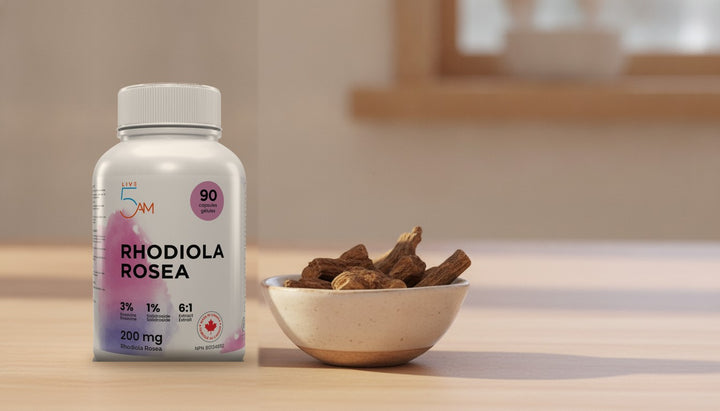
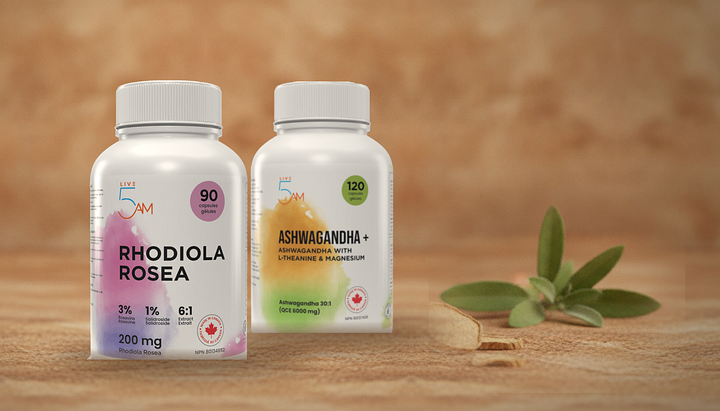
If you're building this out, the simplest structure is a two-slot routine: Rhodiola Rosea 200mg in the morning to support mental clarity and stress-related fatigue through the day, and Ashwagandha+ in the evening to support your wind-down and resistance to stress overnight. It's not a stimulant-and-sedative stack, both are adaptogens working with your stress response, but the AM/PM split mirrors how each ingredient is meant to be used according to its own product monograph.
Give it a few weeks before judging results. Adaptogens aren't built for same-day effects the way caffeine is; most of the clinical evidence behind both ingredients comes from trials running four to twelve weeks, so a fair trial means sticking with the combination for at least a month.
Yes, this is the most common way people combine them; the usual approach is rhodiola earlier in the day and ashwagandha later, matching each ingredient's typical use and the timing guidance on their respective Health Canada monographs.
Splitting them is the more common practice. Rhodiola's monograph advises avoiding it before bedtime, so pairing it with breakfast and saving ashwagandha for the evening tends to work better than taking both together at once.
Most of the clinical research behind each ingredient runs four to twelve weeks, so give the combination at least three to four weeks before evaluating whether it's making a difference for you.
Generally yes for most healthy adults, though rhodiola's activating effect means pairing it with a lot of caffeine could feel like too much stimulation for some people. If you're combining either ingredient with other supplements or medications, review the full list with a healthcare practitioner or pharmacist.
Both have been studied over multi-week periods with generally favorable safety profiles, but neither monograph specifies an approved long-term duration beyond the trial windows they're based on. Many people cycle adaptogens, weeks on followed by a break, and it's worth checking in with a healthcare practitioner for ongoing use, especially alongside medication.
Ashwagandha and rhodiola are two of the better-studied adaptogens individually, and pairing them is a reasonable, widely practiced approach, not because there's a large body of combination-specific trials (there isn't), but because their profiles are genuinely complementary: one calming and evening-leaning, one activating and morning-leaning.
If your stress shows up as one thing, either fatigue and brain fog, or restlessness and poor wind-down, you may only need one. If it shows up as both, splitting rhodiola into your morning and ashwagandha into your evening is a sensible way to structure the pairing.
Start low, introduce one at a time, and loop in a healthcare practitioner if you're pregnant, breastfeeding, on medication, or managing an existing health condition.
This article is for general education and is not medical advice. It does not replace individualized guidance from a qualified healthcare practitioner, particularly if you are pregnant, breastfeeding, taking medication, or under a doctor's care for an existing health condition.
About the Author
Mansour Norouzi is the founder of Live 5AM, a Toronto-based, NPN-licensed supplement brand. He works hands-on with Health Canada-licensed natural health products and writes about supplement science, adaptogens, and longevity ingredients. Every Live 5AM product carries a Natural Product Number (NPN), meaning its ingredients, doses, and claims have been reviewed by Health Canada.

Adaptogen for stress resilience and cognitive support.